 K-Dogam
No. 012 · Tang
Gamjatang Recipe (Korean Pork Bone Soup with Potatoes)
감자탕 · Gamjatang
Servings & Time
2 servings · Prep 80min · Cook 90min
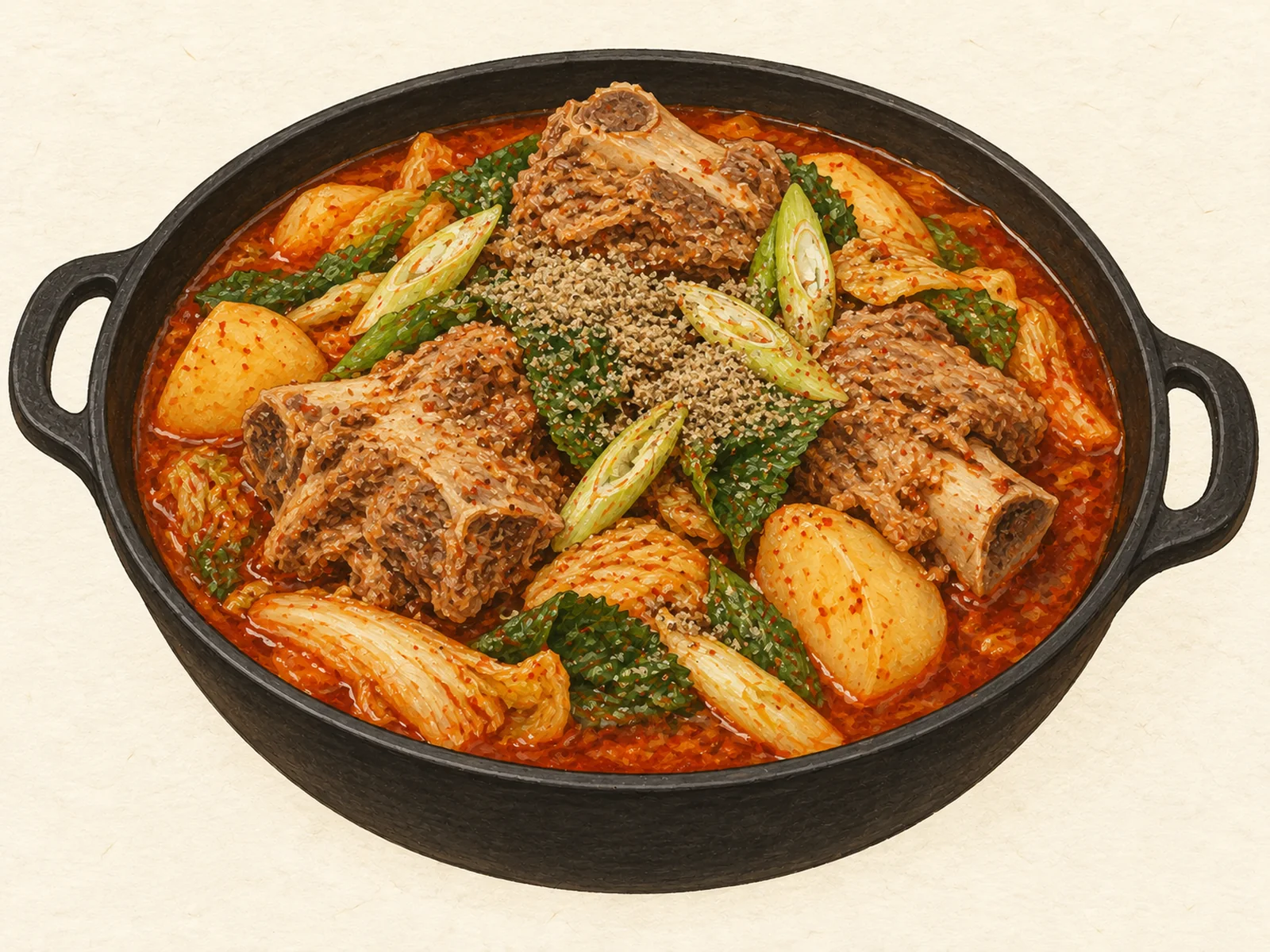
About This Dish
This gamjatang serves two and needs about 1 hour of soaking before about 1 hour and 30 minutes on the stove. Meaty pork neck bones simmer until tender, then cook with potatoes and cabbage in a spicy broth seasoned with doenjang (Korean soybean paste), gochugaru (Korean chili flakes) and ground perilla seeds. The key is to simmer the bones until the meat comes off easily before the vegetables go in.
The name means “potato stew,” but the National Folk Museum of Korea’s encyclopedia notes several views on its origin and states that no records fix its first date or place. The Korean Cultural Center Association describes theories that connect the name to the pork spine or spinal cord rather than to the vegetable.
The Wtable recipe uses boiled siraegi (dried radish greens) or blanched young cabbage. This version uses blanched Korean cabbage leaves and finishes with kkaennip (perilla leaves).
Ingredients
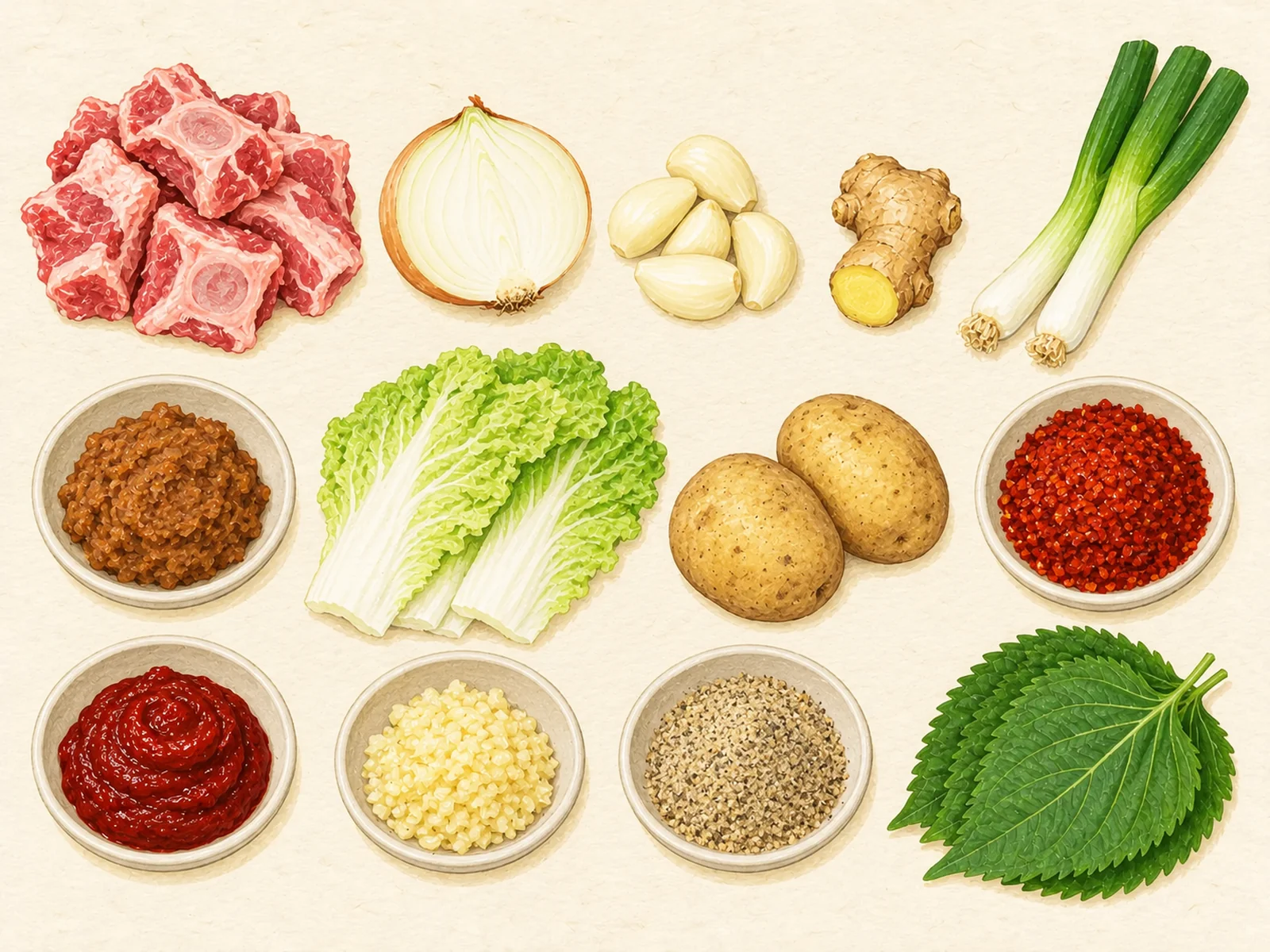
Scroll sideways to see all columns →
| # | Ingredients | Qty | Remarks |
|---|---|---|---|
| 01 | Pork neck bones (pork spine) | About 1 kg (2.2 lb) | Weight with bones. Choose pieces with plenty of meat |
| 02 | Water | About 2 L (8 1/2 cups) | For the broth |
| 03 | Onion | 1/2 ea | |
| 04 | Garlic cloves | 5 cloves | Whole |
| 05 | Ginger | 1 thumb-size piece | Sliced |
| 06 | Green onions | 2 stalks | 1 white part for the broth, 1 stalk cut diagonally for the end |
| 07 | Doenjang (Korean soybean paste) | 2 tbsp | Divided |
| 08 | Korean cabbage leaves | About 150 g (5.3 oz) | |
| 09 | Potatoes, medium | 2 ea (about 300 g / 10.6 oz) | Peeled and halved. Use firm potatoes with no sprouts or green patches; sources still disagree on whether this vegetable gave the dish its name |
| 10 | Gochugaru (Korean chili flakes) | About 2 tbsp | |
| 11 | Gochujang (Korean chili paste) | About 1 tbsp | |
| 12 | Soup soy sauce (guk-ganjang) | About 1 tbsp | |
| 13 | Minced garlic | 1 tbsp | |
| 14 | Ground perilla seeds (deulkkaetgaru) | About 3 tbsp | |
| 15 | Kkaennip (perilla leaves) | 8 leaves |
Equipment
- Large pot, at least 4 L (about 4 1/4 US qt)
- Second pot (for blanching the bones and cabbage)
- Small bowl (for the sauce)
- Slotted spoon or tongs
Instructions
Cover the bones with cold water. Refrigerate them for about 1 hour. Change the water once.
Pork neck bones (pork spine) About 1 kg (2.2 lb)
Bring a pot of water to a boil. Add the bones. When the water boils again, boil for about 5 minutes. Drain the bones. Rinse them in cold water.
Put the bones and water in the large pot. Add the onion, garlic cloves, ginger, doenjang and the white part of 1 green onion. Bring it to a boil over high heat.
Water About 2 L (8 1/2 cups) · Onion 1/2 ea · Garlic cloves 5 cloves · Ginger 1 thumb-size piece · Green onions 1 white part · Doenjang (Korean soybean paste) 1 tbsp
Skim off the foam. Cover the pot. Simmer over medium-low heat for about 60 minutes, until the meat comes off the bone easily.
Meanwhile, blanch the cabbage in boiling water for about 2 minutes. Rinse it in cold water. Squeeze out the water. Cut the cabbage into bite-size pieces.
Korean cabbage leaves About 150 g (5.3 oz)
In a small bowl, mix the gochugaru, gochujang, soup soy sauce, minced garlic, ground perilla seeds and the remaining doenjang.
Gochugaru (Korean chili flakes) About 2 tbsp · Gochujang (Korean chili paste) About 1 tbsp · Soup soy sauce (guk-ganjang) About 1 tbsp · Minced garlic 1 tbsp · Ground perilla seeds (deulkkaetgaru) About 3 tbsp · Doenjang (Korean soybean paste) 1 tbsp
Remove the onion, garlic cloves, ginger and green onion. Add the potatoes, cabbage and sauce. Boil over medium heat for about 20 minutes, until the potatoes are soft.
Potatoes, medium 2 ea (about 300 g / 10.6 oz)
Add the perilla leaves and the remaining green onion. Boil for about 2 minutes. Check that the meat is cooked through.
Kkaennip (perilla leaves) 8 leaves · Green onions 1 stalk
Turn off the heat. Serve hot with rice.
Doneness Check
- The meat is cooked through and comes off the bone easily (optional check: the thickest meat, away from the bone, stays at or above 75°C (167°F) for at least 1 minute)
- The potatoes are soft all the way through
- The broth boils throughout and covers the bones
Variations
- Ppyeo-haejangguk (pork bone hangover soup)
- At one restaurant in Okcheon, the single-serving bowl is sold under this name, while gamjatang comes as a pot for two.
- Siraegi gamjatang
- Boiled siraegi (dried radish greens) replaces the cabbage.
- Mugeunji gamjatang
- Aged kimchi replaces the cabbage or radish greens.
FAQ
What bones should I buy?
Use pork neck bones or pork spine with plenty of meat attached. Korean grocery stores sell them, sometimes frozen. About 1 kg (2.2 lb) with bones serves two in this entry.
Why is my broth thin?
At step 7, cook with the lid off to reduce the broth. Taste it when the potatoes are soft, and adjust the seasoning.
How do I store leftover gamjatang?
Divide it into small, shallow containers and refrigerate within 2 hours after cooking (1 hour if the room is 32°C (90°F) or hotter). Keep it at 4°C (40°F) or below and use it within 3–4 days. Bring it to a full boil when you reheat it.
Does the name come from the potatoes?
It is not settled. The National Folk Museum of Korea's encyclopedia notes several views, and the Korean Cultural Center Association describes theories that link the name to the pork spine rather than to the potato.
Sources
- Maangchi — Gamjatang
- Korean Bapsang — Gamjatang
- My Korean Kitchen — Gamjatang
- Wtable — Gamjatang (Korean)
- Amyzzung — Pressure cooker gamjatang (Korean)
- National Folk Museum of Korea — Gamjatang (Korean)
- Korean Cultural Center Association — Gamjatang story (Korean)
- Okcheon County — Haejangguk and gamjatang (Korean)
- USDA — Washing food and soaking meat
- USDA — Refrigeration and food safety
- MFDS — Cooking meat safely (Korean)
- Centre for Food Safety, Hong Kong — Potato glycoalkaloids
- Jeong et al. — Perilla seed allergy in children (2023)
- Sempio — Doenjang ingredients
- USDA — Leftovers and food safety
- FoodSafety.gov — Cold food storage chart
Compiled and reviewed by Nuri · Published