 K-Dogam
No. 013 · Jjim
Galbi-jjim Recipe (Korean Braised Short Ribs)
갈비찜 · Galbi-jjim
Servings & Time
2 servings · Prep 80min · Cook 110min
About This Dish
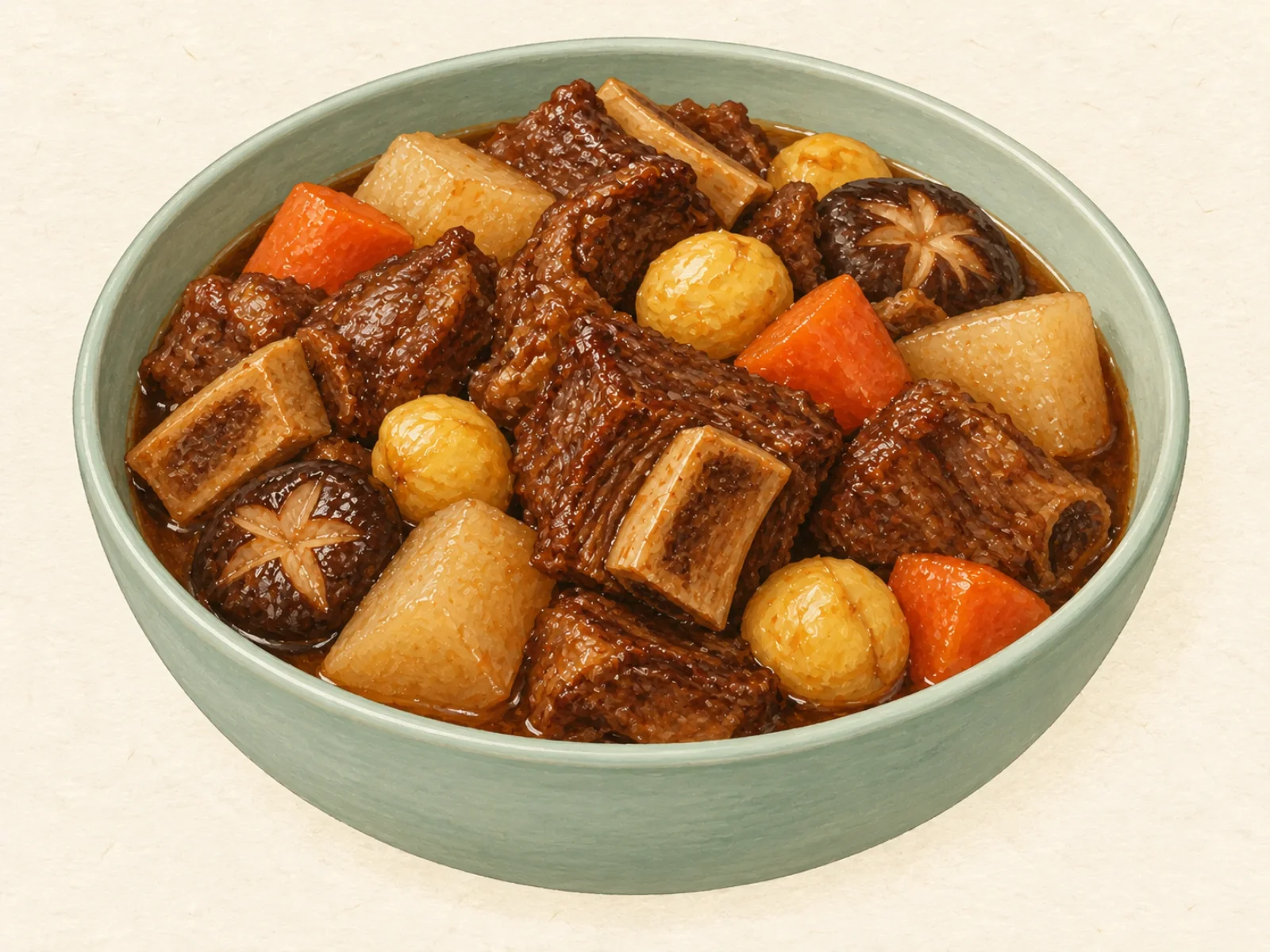
This galbi-jjim serves two and takes about 3 hours and 10 minutes, including soaking and preparation. Bone-in beef short ribs simmer until tender, then braise in a sauce of soy sauce, sugar, grated Korean pear and garlic with radish, carrot, mushrooms and chestnuts. The key is to simmer the ribs first and reduce the sauce slowly until it coats them.
The Encyclopedia of Korean Culture notes that galbi-jjim was also called garijjim and was served at Chuseok, the autumn harvest holiday, in place of braised chicken. The name garijjim also appears in Siuijeonseo, a cookbook whose original is thought to have been compiled in the late 19th century, and in the 1921 edition of Joseon yori jebeop, an early modern Korean cookbook.
A 2008 study of royal records finds galbi-jjim on the 1796 birthday banquet table for Lady Hyegyeong, the mother of King Jeongjo. This shows the dish was served at court banquets, but not that it began at court. Newspapers in the 1960s describe beef ribs as popular holiday gifts and as ingredients for galbi-jjim served to guests at home, though their high price made them hard to afford for many households. The sources reviewed for this entry do not establish where or when the dish began.
Recipes differ in how they start: some simmer the ribs first, others marinate them or use a pressure cooker. This entry simmers the ribs in a regular pot and leaves out ginkgo nuts and jujubes.
Ingredients
Scroll sideways to see all columns →
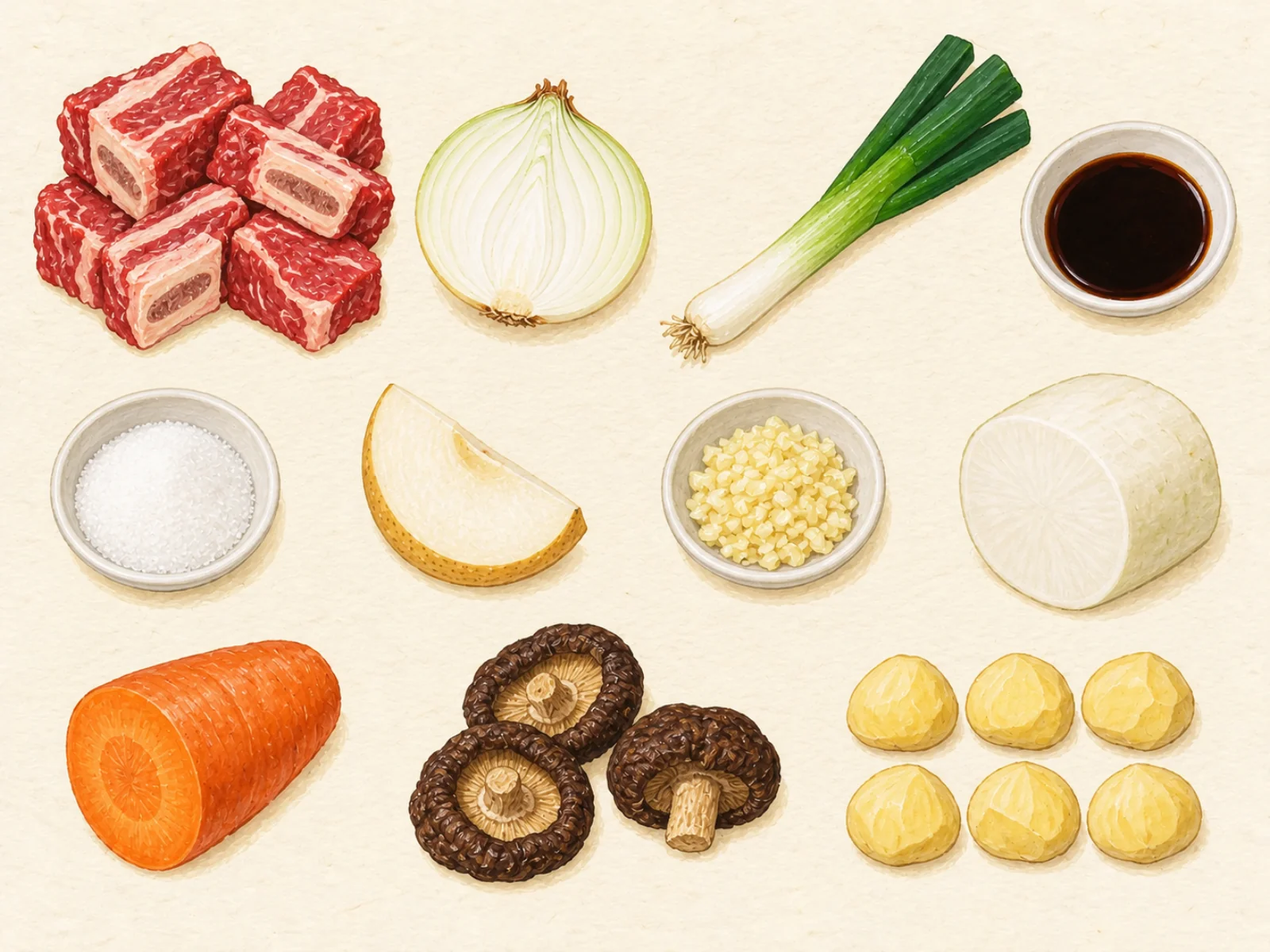
| # | Ingredients | Qty | Remarks |
|---|---|---|---|
| 01 | Bone-in beef short ribs, for braising | About 700 g (24.7 oz) | English-cut pieces, weight with bones |
| 02 | Water | About 1.2 L (5 cups) | For the first simmer |
| 03 | Onion | 1/2 ea | |
| 04 | Green onion | 1 stalk | |
| 05 | Soy sauce | About 4 tbsp | Regular cooking soy sauce, not soup soy sauce |
| 06 | Sugar | About 1 1/2 tbsp | |
| 07 | Korean pear, grated | 1/4 ea (about 100 g / 3.5 oz) | |
| 08 | Minced garlic | About 1 tbsp | |
| 09 | Black pepper | A pinch | |
| 10 | Korean radish (mu) | About 150 g (5.3 oz) | Cut into chunks with the edges trimmed |
| 11 | Carrot | 1/2 ea | Cut into chunks |
| 12 | Dried pyogo mushrooms (Korean dried mushrooms) | 3 ea | Soaked in water for about 30 minutes, until soft; soak longer if still firm |
| 13 | Peeled chestnuts | 6 ea | |
| 14 | Sesame oil | About 1 tsp |
Equipment
- Heavy pot, at least 3 L (about 3 1/4 US qt), with a lid
- Second pot (for blanching)
- Grater
- Small bowl (for the sauce)
Instructions
Cover the ribs with cold water. Refrigerate them for about 1 hour.
Bone-in beef short ribs, for braising About 700 g (24.7 oz)
Boil the ribs in a pot of water for about 5 minutes. Drain the ribs. Rinse the ribs. Cut off thick fat.
Put the ribs, water, onion and green onion in the heavy pot. Bring it to a boil over high heat. Cover the pot. Simmer over medium-low heat for about 60 minutes.
Water About 1.2 L (5 cups) · Onion 1/2 ea · Green onion 1 stalk
Meanwhile, mix the soy sauce, sugar, grated pear, garlic and pepper in a small bowl.
Soy sauce About 4 tbsp · Sugar About 1 1/2 tbsp · Korean pear, grated 1/4 ea (about 100 g / 3.5 oz) · Minced garlic About 1 tbsp · Black pepper A pinch
Soak the mushrooms in water for about 30 minutes. Cut the radish and carrot.
Korean radish (mu) About 150 g (5.3 oz) · Carrot 1/2 ea · Dried pyogo mushrooms (Korean dried mushrooms) 3 ea
Remove the onion and green onion. Skim off the fat. Keep about 500 ml (2 cups) of the broth in the pot.
Add the sauce, radish and carrot. Cover the pot. Boil over medium heat for about 20 minutes.
Add the mushrooms and chestnuts. Boil uncovered for about 15 minutes, until the sauce is reduced and the radish is soft. Check that the meat is tender and cooked through.
Peeled chestnuts 6 ea
Add the sesame oil. Turn off the heat. Serve with rice.
Sesame oil About 1 tsp
Doneness Check
- The meat is tender and comes away from the bone (optional check: the thickest meat, away from the bone, stays at or above 75°C (167°F) for at least 1 minute)
- The radish and carrot are soft all the way through
- The sauce is reduced and coats the ribs, with a little left in the pot
Variations
- Dwaeji galbi-jjim (pork rib version)
- Pork ribs replace the beef; the recipe checked for this entry uses no pear and pre-boils the ribs for about 10 minutes.
- Spicy galbi-jjim
- Gochugaru (Korean chili flakes) and hot green chilies join the soy sauce, and one recipe adds garaetteok (cylinder rice cakes).
- Garnished galbi-jjim
- The encyclopedia describes chestnuts, ginkgo nuts, jujubes and mushrooms, topped with thin egg strips.
Similar Dishes
- LA galbi (grilled short ribs)
- LA galbi is a related species from the same short ribs, sliced thinly across the bone and moved from the pot to the grill.
FAQ
Which short ribs should I buy?
Ask for bone-in beef short ribs, English-cut, for braising. Thin flanken or LA-cut ribs are sliced across the bone for grilling and do not suit this cooking time.
Do I need to marinate the ribs first?
No. In this entry, the ribs simmer first, then cook in the sauce. Some recipes marinate the ribs in the refrigerator before cooking.
How do I store leftover galbi-jjim?
Refrigerate leftovers in small, shallow containers within 2 hours after cooking (1 hour if the room is 32°C (90°F) or hotter), keep them at 4°C (40°F) or below, and use them within 3–4 days. Lift off the hardened fat once cold, and reheat until all parts reach 74°C (165°F).
What if the galbi-jjim is too salty?
Add a little water and simmer briefly, then taste again. The sauce gets saltier as it reduces, so taste before the last reduction.
Sources
- Korean Bapsang — Galbijjim
- Maangchi — Galbi-jjim
- My Korean Kitchen — Galbi-jjim
- Korean Bapsang — LA galbi
- Wtable — Beef galbi-jjim (Korean)
- Wtable — Pork galbi-jjim (Korean)
- Wtable — Spicy beef galbi-jjim (Korean)
- Kim Jin-ok — Tender beef galbi-jjim (Korean)
- Encyclopedia of Korean Culture — Galbi-jjim (Korean)
- MFDS — Cooking meat safely (Korean)
- USDA — Food thermometers
- USDA — Washing food and soaking meat
- Instant Pot — Pressure cooker FAQ
- Kansas State University — Skimming the fat
- Lee et al. — Chestnut allergens (2005)
- USDA — Leftovers and food safety
- FoodSafety.gov — Cold food storage chart
- Encyclopedia of Korean Culture — Siuijeonseo (in Korean)
- Korean Traditional Knowledge Portal — Garijjim in Siuijeonseo (in Korean)
- Korean Traditional Knowledge Portal — Garijjim in Joseon yori jebeop, 1921 edition (in Korean)
- Ok Yeong-jeong — A bibliographical analysis of the Jeongni uigwe, royal records written in Korean (2008, in Korean)
- Maeil Business Newspaper — Beef ribs, 1966 (in Korean)
- Maeil Business Newspaper — Beef ribs, 1967 (in Korean)
Compiled and reviewed by Nuri · Published · Updated