 K-Dogam
No. 008 · Bap
Beef Bibimbap Recipe (Korean Mixed Rice Bowl)
비빔밥 · Bibimbap
Servings & Time
2 servings · Prep 25min · Cook 25min
About This Dish
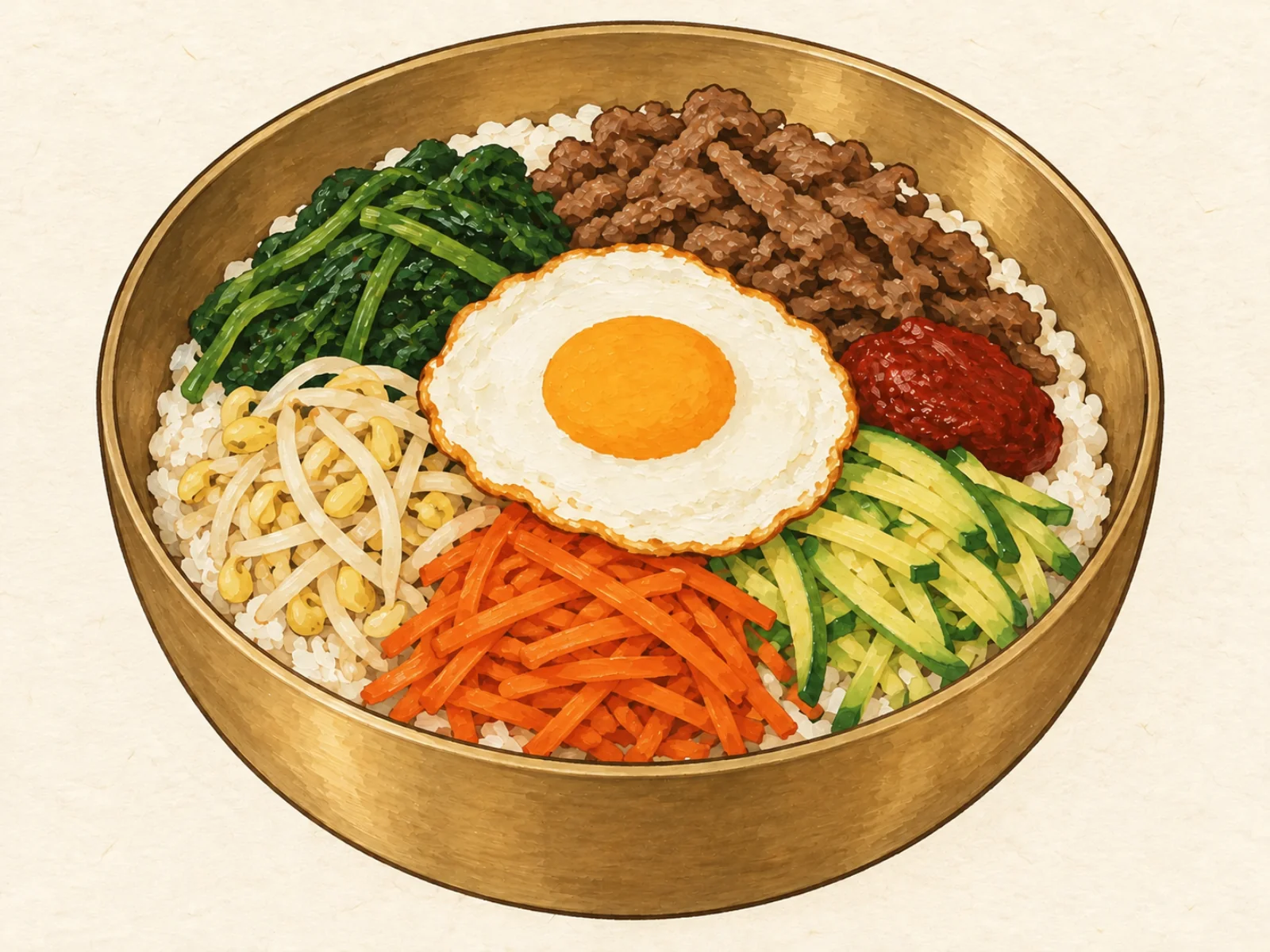
This beef bibimbap serves two in about 50 minutes, starting from cooked rice. Warm rice is topped with four seasoned vegetables, soy-marinated beef and a fried egg, then mixed at the table with a sauce made from gochujang (Korean chili paste). The key is to season each vegetable lightly, because the sauce adds salt and heat.
Bibimbap means “mixed rice.” The toppings differ from recipe to recipe: the published recipes compared for this entry each used a different set of namul (seasoned vegetables), and some added gosari (bracken) or doraji (bellflower root). This entry uses soybean sprouts, spinach, carrot and aehobak (Korean summer squash).
Siuijeonseo, a cookbook whose original is thought to have been compiled in the late 19th century, records goldongban, also called bubuimbap: rice mixed with meat, namul and fried kelp. Customs of mixing food from ancestral rites, or leftover food on Lunar New Year’s Eve, into rice are also described, but the sources reviewed do not establish them as the origin of bibimbap. In 1929, the magazine Byeolgeongon described Jinju bibimbap topped with yukhoe (seasoned raw beef) and gochujang.
The sprouts and spinach share one pot of boiling water, and the carrot, aehobak, beef and eggs share one pan, in that order. Serve the sauce on the side, so each person can add as much as they like.
Ingredients
Scroll sideways to see all columns →
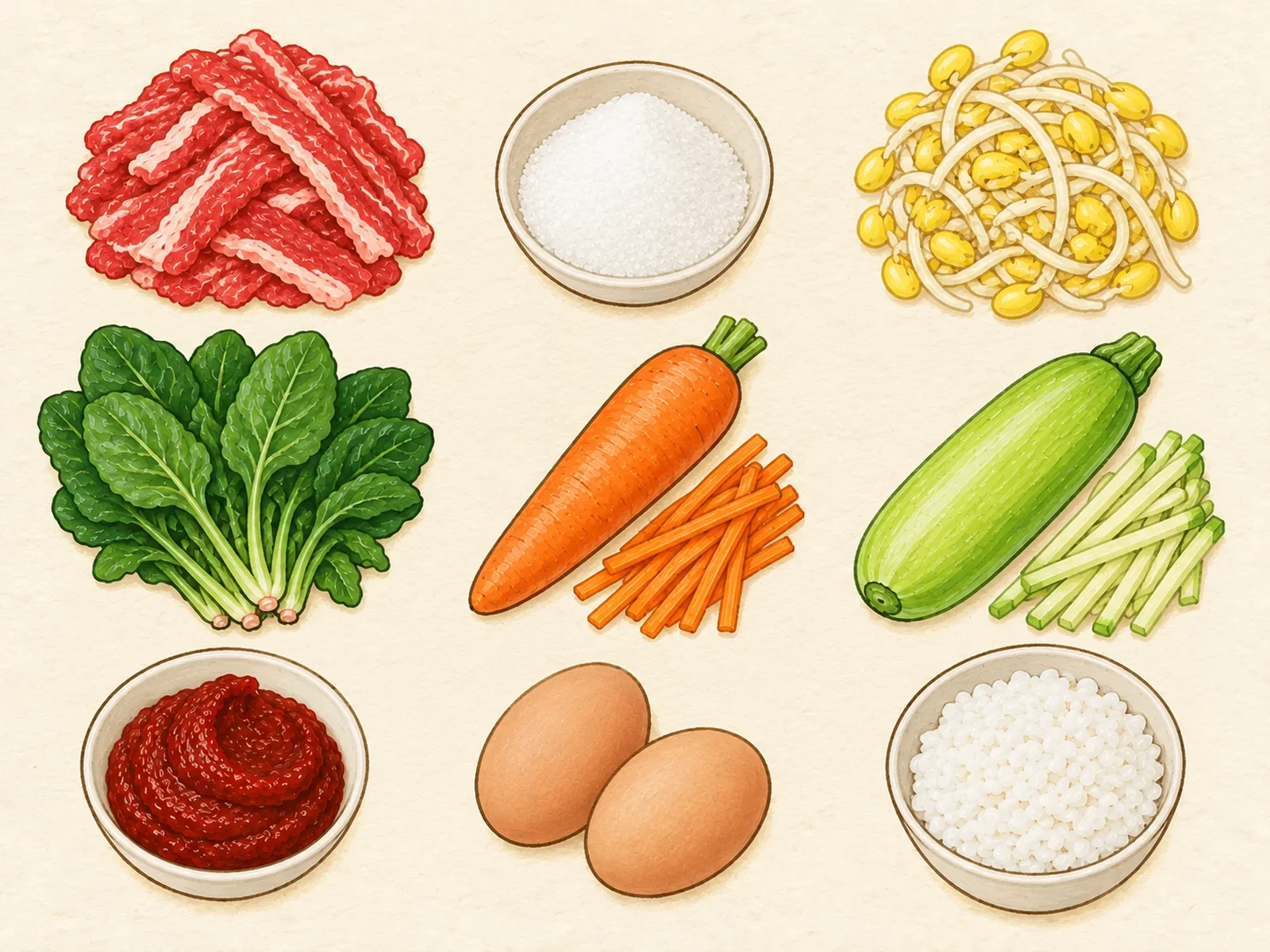
| # | Ingredients | Qty | Remarks |
|---|---|---|---|
| 01 | Beef, thinly sliced | About 150 g (5.3 oz) | Ribeye or sirloin, 2–3 mm (about 1/8 in) thick. Alt: ground beef, no cutting |
| 02 | Soy sauce | 1 tbsp | Regular cooking soy sauce, not soup soy sauce |
| 03 | Sugar | 2 1/2 tsp | 1/2 tbsp for the beef, 1 tsp for the sauce |
| 04 | Minced garlic | 1/2 tsp | |
| 05 | Sesame oil | 1 1/2 tbsp | Divided |
| 06 | Black pepper | A pinch | |
| 07 | Kongnamul (soybean sprouts) | About 150 g (5.3 oz) | Alt: mung bean sprouts. Cook them fully; the time can differ |
| 08 | Salt | 1/2 tsp + 2 pinches | Divided |
| 09 | Spinach | About 150 g (5.3 oz) | Raw weight |
| 10 | Carrot | 1/2 ea (about 70 g / 2.5 oz) | Thin matchsticks |
| 11 | Cooking oil | 4 tsp | Divided |
| 12 | Aehobak (Korean summer squash) | 1/3 ea (about 100 g / 3.5 oz) | Thin matchsticks. Alt: zucchini |
| 13 | Gochujang (Korean chili paste) | 2 tbsp | |
| 14 | Water | 1/2 tbsp | For the sauce |
| 15 | Toasted sesame seeds | 1 tsp | |
| 16 | Eggs | 2 ea | |
| 17 | Cooked short-grain white rice | About 400 g (14.1 oz) | Warm. Cooking the rice is not included in the total of about 50 minutes |
Equipment
- Pot, 18–20 cm (about 7–8 in), for blanching
- Frying pan, 24–26 cm (about 9 1/2–10 1/4 in)
- Slotted spoon or strainer
- Small bowls (for the marinade and the sauce)
- Plates (for the cooked toppings)
- 2 wide serving bowls
Instructions
Cut the beef into thin strips, about 5 mm (1/4 in) wide.
Beef, thinly sliced About 150 g (5.3 oz)
In a bowl, mix the soy sauce, sugar, garlic, sesame oil and pepper. Add the beef. Mix well.
Soy sauce 1 tbsp · Sugar 1/2 tbsp · Minced garlic 1/2 tsp · Sesame oil 1 tsp · Black pepper A pinch
Cover the bowl. Marinate the beef in the refrigerator for about 10 minutes.
Bring a pot of water to a boil. Add the sprouts. Boil them for about 4 minutes, until fully cooked.
Kongnamul (soybean sprouts) About 150 g (5.3 oz)
Lift out the sprouts. Drain them. Mix in the salt and sesame oil.
Salt 1/4 tsp · Sesame oil 1 tsp
Put the washed spinach into the same boiling water. Remove it after about 30 seconds, when the leaves soften.
Spinach About 150 g (5.3 oz)
Rinse the spinach in cold water. Squeeze out the water. Discard the blanching water. Mix in the salt and sesame oil.
Salt 1/4 tsp · Sesame oil 1 tsp
Heat the pan over medium heat. Add oil. Stir-fry the carrot with a pinch of salt for about 1 minute, until slightly soft. Transfer it to a plate.
Carrot 1/2 ea (about 70 g / 2.5 oz) · Cooking oil 1 tsp · Salt A pinch
Add oil to the pan. Stir-fry the aehobak with a pinch of salt for about 1 minute, until just soft. Transfer it to a separate plate.
Aehobak (Korean summer squash) 1/3 ea (about 100 g / 3.5 oz) · Cooking oil 1 tsp · Salt A pinch
Add oil. Increase the heat to medium-high. Cook the beef for about 3 minutes, until it is fully cooked. Transfer it to a plate. Turn off the heat.
Cooking oil 1 tsp
In a small bowl, mix the gochujang, sugar, sesame oil, water and sesame seeds.
Gochujang (Korean chili paste) 2 tbsp · Sugar 1 tsp · Sesame oil 1/2 tbsp · Water 1/2 tbsp · Toasted sesame seeds 1 tsp
Heat the pan over medium heat. Add oil. Fry the eggs until the white and yolk are fully set.
Cooking oil 1 tsp · Eggs 2 ea
Divide the rice between the two bowls. Arrange the vegetables and beef on top. Put an egg in the center.
Cooked short-grain white rice About 400 g (14.1 oz)
Serve with the sauce. Add the sauce to taste. Mix everything before you eat.
Doneness Check
- The beef is fully cooked (optional check: the center stays at or above 75°C (167°F) for at least 1 minute, with a probe inserted sideways)
- The sprouts are hot throughout and fully cooked
- The spinach is soft, and no water collects under it
- The carrot and aehobak are just soft and keep their color
- The egg white and yolk are fully set
Variations
- Dolsot bibimbap
- The rice and toppings go into a heated stone bowl brushed with sesame oil, so the bottom rice turns crisp.
- Jeonju bibimbap
- A regional style from Jeonju. Sources describe it with rice cooked in broth and many toppings, such as hwangpomuk (yellow mung bean jelly).
- Yukhoe bibimbap
- It replaces the cooked beef with seasoned raw beef, which carries a risk of food poisoning.
- Sanchae bibimbap
- Wild mountain greens such as chwinamul (aster greens) and gosari (bracken) make up most of the toppings.
Similar Dishes
- Hoe-deopbap
- Maangchi's English record lists it under the alias 'raw fish bibimbap', but this separate species is topped with raw fish and raw vegetables.
FAQ
What vegetables go in bibimbap?
Common choices include spinach, soybean or mung bean sprouts, carrot, aehobak or zucchini, mushrooms, gosari (bracken) and doraji (bellflower root). Use gosari that has already been soaked and cooked, and follow any package instructions. Cook and season each vegetable separately.
Is bibimbap sauce the same as gochujang?
Gochujang is the chili paste itself, not the finished sauce. The sauce in this entry mixes gochujang with a little sugar, sesame oil, water and sesame seeds. Some recipes serve plain gochujang instead.
Can I make the toppings ahead?
Yes. Refrigerate the cooked vegetables and beef in separate shallow containers within 2 hours (1 hour if the room is 32°C (90°F) or hotter), keep them at 4°C (40°F) or below, and use them within 3–4 days. Serve the vegetables cold, and reheat the beef until all parts reach at least 74°C (165°F).
Can I make bibimbap without meat?
Yes. Leave out the beef and add pan-fried tofu or stir-fried mushrooms. For an egg-free bowl, leave out the egg.
Do I need a stone bowl?
No, a regular bowl works for this entry. Dolsot bibimbap uses a heated stone bowl to make the bottom rice crisp.
Sources
- Maangchi — Bibimbap
- Korean Bapsang — Bibimbap
- My Korean Kitchen — Bibimbap
- Love and Lemons — Bibimbap
- Maangchi — Hoe-deopbap
- Kim Jin-ok — Beef bibimbap (Korean)
- 10000recipe — Easy beef bibimbap (Korean)
- 10000recipe — Dolsot bibimbap (Korean)
- Travie — Regional bibimbap (Korean)
- Korea Tourism Organization — Jeonju bibimbap
- Korea Tourism Organization — Yukhoe bibimbap
- My Korean Kitchen — Dolsot bibimbap
- MFDS — Cooking meat safely (Korean)
- USDA — Thermometer use for thin meat (PDF)
- FDA — Egg safety
- FDA — Selecting and serving produce safely
- CDC — Safer food choices
- UConn Extension — Handling food leftovers
- Illinois Extension — Grilling and summer food safety
- USDA — Leftovers and food safety
- National Folk Museum of Korea — Bibimbap (in Korean)
- National Folk Museum of Korea — Goldongban (in Korean)
- Encyclopedia of Korean Culture — Bibimbap (in Korean)
- Encyclopedia of Korean Culture — Siuijeonseo (in Korean)
- National Institute of Korean History — Byeolgeongon, "Yeongnam jinmi Jinju bibimbap," 1929, p. 65; the database lists a different title (in Korean)
Compiled and reviewed by Nuri · Published · Updated