 K-Dogam
No. 001 · Jjigae
Kimchi Jjigae with Pork Recipe (Kimchi Stew)
김치찌개 · Kimchi-jjigae
Servings & Time
2 servings · Prep 10min · Cook 30min
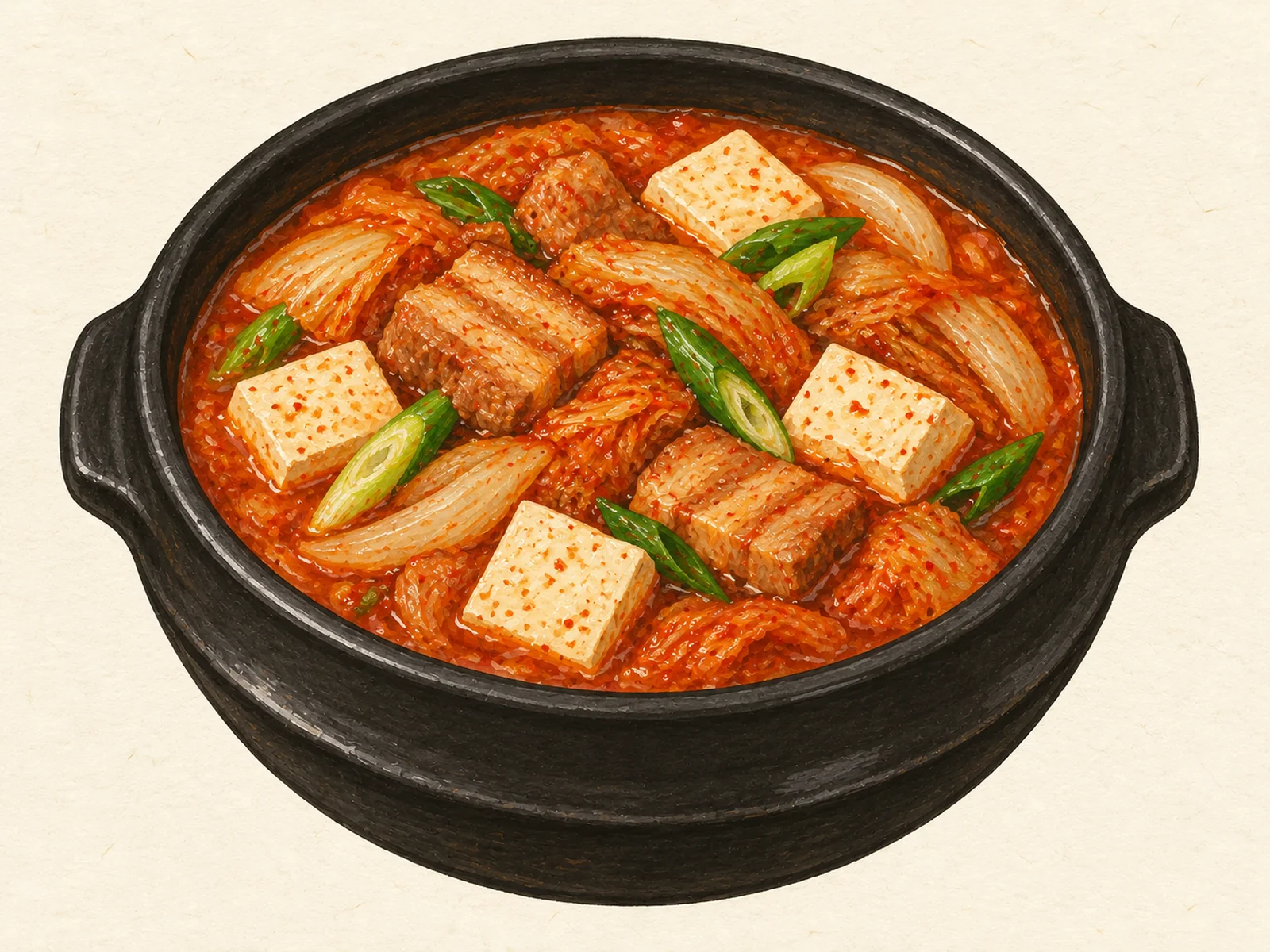
About This Dish
This pork kimchi jjigae serves two in about 40 minutes. Sour cabbage kimchi and pork belly are stir-fried in the pork’s own fat, simmered with water and kimchi brine, and finished with tofu. The one thing that decides the result is the kimchi: it should taste clearly sour.
This kimchi jjigae uses well-fermented kimchi that has become too sour to enjoy as a side dish. That tang is exactly what gives the broth its depth, so this recipe starts with distinctly sour kimchi that has been kept properly in the fridge.
Kimchi jjigae is thought to have begun as a way to use up leftover kimchi or sour winter kimchi. A 1931 cooking column in the Dong-A Ilbo newspaper already gave the name kimchi jjigae and a method that cooks kimchi with meat. In 1968, a Kyunghyang Shinmun article described sour winter kimchi simmered into stew for the winter table.
Ingredients
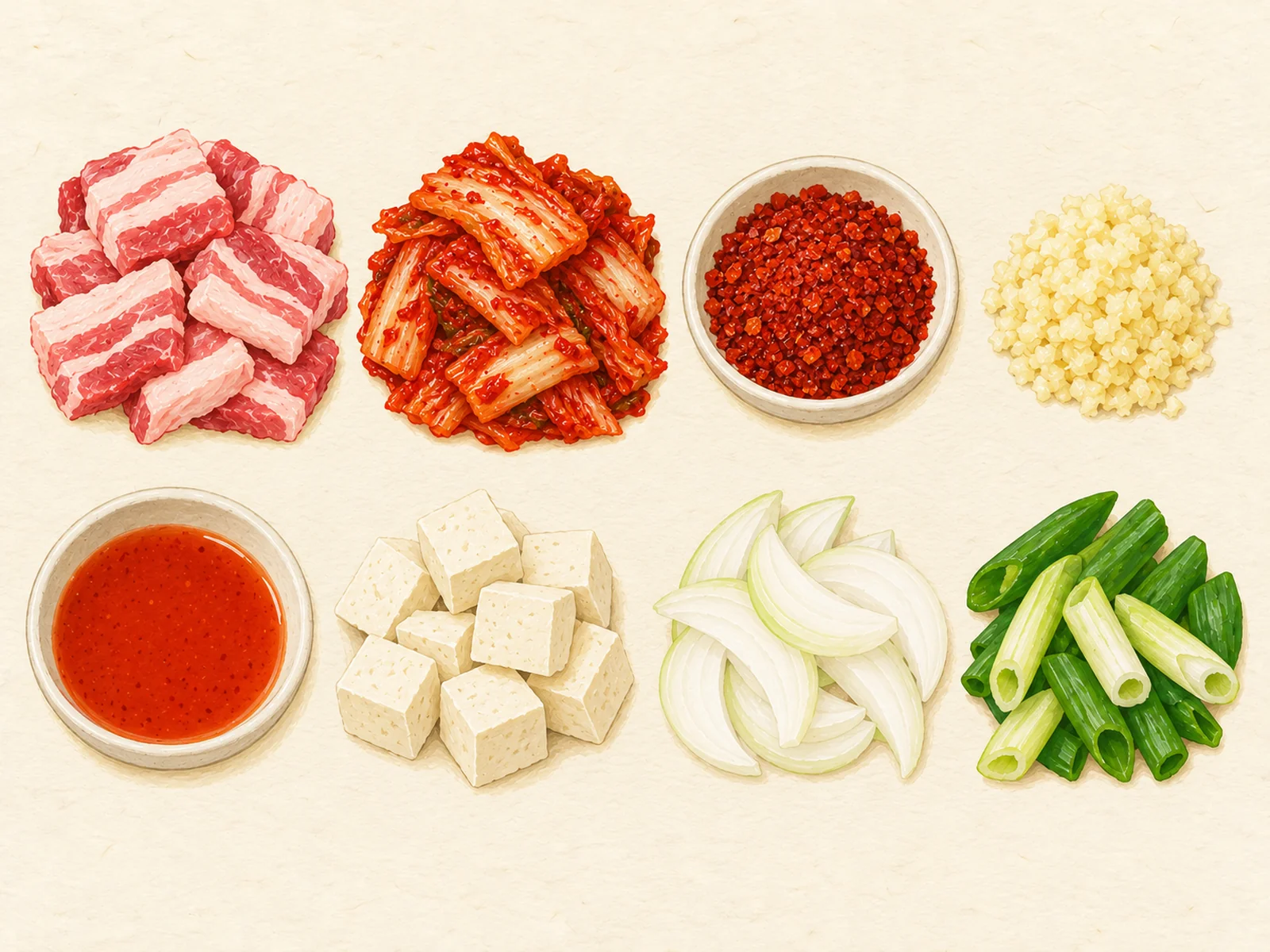
Scroll sideways to see all columns →
| # | Ingredients | Qty | Remarks |
|---|---|---|---|
| 01 | Pork belly | 150 g (5.3 oz) | 1 cm (about 3/8 in) thick, pieces about 2–3 cm (about 3/4–1 1/8 in) across. Alt: pork shoulder |
| 02 | Well-fermented baechu kimchi (Korean cabbage kimchi) | 300 g (10.6 oz) | Clearly sour kimchi preferred. See the FAQ for fresh-kimchi adjustments |
| 03 | Gochugaru (Korean chili flakes) | 1 tbsp | Adjust for heat |
| 04 | Minced garlic | 1 tsp | |
| 05 | Water or anchovy stock | 500 ml (about 2 cups) | Use ready-made stock. Making stock and cooking rice are not included in the 40-min total |
| 06 | Kimchi brine | 60 ml (about 1/4 cup) | From the kimchi container |
| 07 | Soup soy sauce (guk-ganjang) | 1 tsp | Alt: regular soy sauce. Salinity varies by product; start with the same amount, then taste |
| 08 | Sugar | 1/2 tsp | Only if kimchi is overly sour |
| 09 | Medium-firm or firm tofu | 150 g (5.3 oz) | Cut into 1.5 cm (about 5/8 in) cubes |
| 10 | Onion | 1/2 ea | Sliced |
| 11 | Green onion | 1 stalk | Cut diagonally |
Equipment
- Pot, 18–20 cm (about 7 1/8–7 7/8 in), or ttukbaegi (earthenware pot)
- Wooden spatula
- Ladle
Instructions
Cut kimchi into 3 cm (about 1 1/8 in) pieces. Reserve the brine.
Well-fermented baechu kimchi (Korean cabbage kimchi) 300 g (10.6 oz)
Place pot on medium heat. Add pork belly. Cook 3–4 min until fat renders and surface turns light brown.
Pork belly 150 g (5.3 oz)
Add kimchi. Stir-fry for about 5 min until kimchi softens and its edges turn translucent. Stir often.
Well-fermented baechu kimchi (Korean cabbage kimchi) 300 g (10.6 oz)
Add gochugaru and garlic. Stir-fry 30 sec.
Gochugaru (Korean chili flakes) 1 tbsp · Minced garlic 1 tsp
Add water and kimchi brine. Bring to a full boil on high heat.
Water or anchovy stock 500 ml (about 2 cups) · Kimchi brine 60 ml (about 1/4 cup)
Reduce to medium heat. Simmer 10 min from this point.
Taste. Season with up to 1 tsp soup soy sauce.
Soup soy sauce (guk-ganjang) 1 tsp
Add up to 1/2 tsp sugar only if the stew tastes too sour.
Sugar 1/2 tsp
Add tofu and onion. Simmer about 5 min until tofu is hot through.
Medium-firm or firm tofu 150 g (5.3 oz) · Onion 1/2 ea
Add green onion. Turn off heat. Serve with rice.
Green onion 1 stalk
Doneness Check
- Broth is red-orange and slightly glossy with fat
- Kimchi is soft, not crunchy
- Pork is fully cooked, no pink. For certainty, the center stays at or above 75°C (167°F) for at least 1 minute
- Tofu cubes are hot through and intact
Variations
- Tuna kimchi jjigae
- Canned tuna replaces the pork, sometimes added with its oil for a nutty richness.
- Spam and tuna kimchi jjigae
- Canned ham and tuna are fried first to release fat, then the kimchi goes in.
Similar Dishes
- Kimchi guk
- Kimchi guk is a broth-focused kimchi soup that can also contain gochujang (Korean chili paste), so it is not always clear or mild.
FAQ
What kind of kimchi works best?
Well-fermented baechu kimchi (Korean cabbage kimchi) that tastes clearly sour. Freshly made kimchi gives a flat, mild stew; if it is all you have, a small splash of vinegar can add some of the missing tang, though not the depth of aged kimchi.
Can I use water instead of anchovy stock?
Yes. Plain water works because the kimchi and pork carry most of the flavor. Anchovy, chicken or vegetable stock, or water from rinsing rice, all add body.
Which tofu should I use?
Medium-firm or firm tofu holds its shape during simmering. Soft tofu also works but breaks easily, so add it last and stir gently.
What if the stew is too sour?
Add up to 1/2 tsp sugar after tasting at step 7 to balance the sourness.
How long does leftover kimchi jjigae keep?
Refrigerate it within 2 hours in shallow containers and eat it within 3–4 days. Reheat until it boils all the way through.
Sources
- Maangchi — Kimchi stew (Kimchi-jjigae)
- Korean Bapsang — Kimchi Jjigae (Kimchi Stew)
- My Korean Kitchen — Kimchi Jjigae
- Simply Recipes — Kimchi Jjigae (Korean Kimchi Stew)
- Beyond Kimchee — Kimchi Jjigae
- 10000recipe — Pork kimchi jjigae (Korean)
- Sempio — Soy sauce types and salinity (Korean)
- The Kitchn — Preventing fumes when cooking chiles
- FoodSafety.gov — Cold food storage chart
- MFDS — Safe holiday food preparation (Korean)
- 10000recipe — Tuna kimchi jjigae (Korean)
- 10000recipe — Spam and tuna kimchi jjigae (Korean)
- Better Korean — Differences between jjigae, guk and tang
- Maangchi — Kimchi guk
- USDA — Leftovers and food safety
- Encyclopedia of Korean Culture — Kimchi jjigae (in Korean)
- Dong-A Ilbo — Cooking column on jjigae, 1931 (in Korean)
- Kyunghyang Shinmun — Kimchi jjigae column, 1968 (in Korean)
Compiled and reviewed by Nuri · Published · Updated